Guide
What VIP (vasoactive intestinal peptide) is: background on the neuropeptide
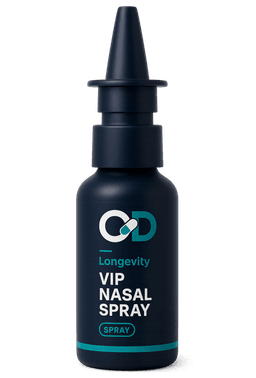 Discussed in this guideVIP Nasal Sprayfrom $149.00
A plain-language, mechanism-focused look at the neuropeptide VIP — what it is, the receptors it acts on, and the signaling and immune roles studied in research.
On this page
What VIP is, and where its name comes from
VIP, short for vasoactive intestinal peptide, is a 28-amino-acid neuropeptide — a short chain of amino acids that acts as a signaling molecule in the nervous system. It was first isolated in 1970 by the researchers Sami Said and Viktor Mutt, who purified it from intestinal tissue. The name records two of the earliest observations about it: it was recovered from the intestine, and it relaxed blood vessels, a property described as vasoactive. Both halves of the name are historical descriptions of how the molecule was found and what it was first seen to do, not a summary of everything it is now understood to be involved in.
Structurally, VIP belongs to a group of related signaling molecules often called the secretin/glucagon peptide superfamily, which includes secretin, glucagon, and a close relative called PACAP (pituitary adenylate cyclase-activating polypeptide). In the decades since its discovery, VIP has been found far beyond the gut. It is widely distributed through both the central and peripheral nervous systems and is released not only by neurons but also by certain endocrine and immune cells. For that reason it is generally described as a broadly used chemical messenger rather than a hormone tied to a single organ.
This article describes what VIP is and the signaling roles studied in research. It is educational only, is not medical advice, and does not describe VIP as a treatment for any condition. Its purpose is to provide background on the neuropeptide, not to suggest what any product does or what any individual should expect.
The receptors VIP acts on
VIP is understood to act by binding to G-protein-coupled receptors (GPCRs) — cell-surface proteins that relay a signal from outside the cell to the machinery inside it. VIP's receptors belong to a group known as class B, or the secretin-receptor family, which recognize peptide hormones through a large region that sits on the outside of the cell. Three receptors are central to most descriptions of VIP: VPAC1, VPAC2, and PAC1.
VPAC1 and VPAC2 are understood to bind VIP and its relative PACAP with broadly similar affinity, while PAC1 is described as having higher affinity for PACAP and lower affinity for VIP. The receptors are not distributed evenly across the body. VPAC1 has been described in tissues including the brain, T lymphocytes, liver, lung, and intestine, while VPAC2 is associated with regions such as the hippocampus, spinal cord, and smooth muscle. Where a receptor is expressed helps shape where VIP signaling can take place, which is part of why the peptide is studied in so many different systems.
When VIP binds one of these receptors, the receptor is understood to couple mainly to a signaling protein called Gs, which activates the enzyme adenylate cyclase. That enzyme raises the level of a small intracellular messenger, cyclic AMP (cAMP), which in turn activates protein kinase A (PKA); downstream, the signal can also engage other kinases such as ERK. This cAMP–PKA cascade is the classic pathway understood to underlie many of the effects studied for VIP, including smooth-muscle relaxation and secretion. Describing the pathway is a description of cell biology, not a claim about a result in any person.
Signaling roles studied in research
Because VIP and its receptors appear in many tissues, the peptide is studied across a range of physiological contexts. The vasodilation that gave VIP the "vaso" in its name reflects its association with relaxation of smooth muscle — the muscle found in the walls of blood vessels and hollow organs. Within the digestive tract, VIP is studied in the context of ion and water secretion and of gut motility, the coordinated muscle activity that moves contents through the intestine. These are descriptions of processes researchers have linked to VIP signaling, not statements about what a product does.
VIP also draws attention in the central nervous system. A population of VIP-producing neurons sits in the suprachiasmatic nucleus, a small region often described as the brain's master circadian clock, and VIP is studied for its role in helping coordinate timing signals among the clock's neurons. The peptide is also examined in the context of endocrine and pituitary signaling. Across each of these areas, VIP is discussed as one of many messengers participating in a larger network rather than as the sole driver of any single function.
Framing matters here. Each of these roles is a description of biology observed in research settings — often in cell and animal models — and describing that biology is not the same as claiming that any preparation of VIP changes it in a given person. Whether, where, and to what degree VIP signaling is engaged in a specific human context are scientific questions that continue to be studied, and this article does not attempt to answer them.
The immune-modulation role studied in research
One area that has drawn particular research attention is VIP's relationship to the immune system. The VPAC1 and VPAC2 receptors have been described on a range of immune cells, including:
- T lymphocytes
- Macrophages
- Dendritic cells
- Mast cells
And VIP itself can be released by some immune cells. That combination means VIP is studied not only as a signal traveling from nerves to other tissues but also as a messenger acting within the immune system.
Inside these cells, VIP signaling is understood to run through the same cAMP pathway described earlier, engaging a transcription factor called CREB and, in many descriptions, dampening the activity of NF-κB — a regulatory switch that helps turn on inflammatory genes. Through mechanisms like these, VIP has been studied as a modulator of both innate and adaptive immune responses and is frequently characterized in the research literature as having anti-inflammatory or immunomodulatory properties. These are descriptions of signaling mechanisms observed in study, hedged accordingly, rather than statements of a clinical effect.
It is worth stating plainly what this body of work is and is not. It describes pathways examined largely in laboratory and preclinical settings and in ongoing research; it is not evidence that a VIP product produces a benefit in a person, and nothing here should be read as an outcome claim. How any of this mechanism translates to a specific individual is not settled science, and whether VIP is appropriate for anyone is a clinical judgment that belongs to a licensed provider, not to a general explainer.
Forms, administration, and regulatory status
VIP is a peptide, and peptides are generally broken down by the acid and enzymes of the digestive tract, so VIP is not typically prepared as a swallowed tablet. Non-oral routes are used instead; intranasal delivery, as a nasal spray, and injectable forms are among the routes seen in compounded preparations. The specifics of any given preparation — its concentration and configuration — vary, and the prescription defines how a product is to be used. This article does not provide dosing guidance of any kind; any schedule or amount is set by the prescribing provider, not by educational content.
Regulatory status is worth stating clearly. VIP itself is not an FDA-approved product. A synthetic form of VIP, known as aviptadil, has been examined in investigational clinical research and has carried certain procedural designations, but investigational study and regulatory designations are not the same as FDA approval, and they should not be read as approval. Compounded VIP preparations are prepared by a licensed pharmacy to fill an individual prescription and are not themselves FDA-approved — a neutral statement about the compounding pathway rather than a judgment about quality either way.
Because VIP is prescription-only and can carry considerations that depend on a person's health history and other medications, evaluation by a licensed provider is central to the process. A medical intake is designed to surface those factors so the reviewing clinician has the context needed to make a decision. Nothing here is a substitute for that clinical review.
How prescription review works on OpenDoseRx
On OpenDoseRx, the process is built so that a clinician — not the shopper — makes the medical decision. You begin by choosing a product and strength, then complete a medical intake that collects your health history and other relevant information. That intake is routed to an independent, licensed U.S. provider who reviews it.
If the provider determines that a prescription is appropriate, it is sent to a licensed U.S. pharmacy for fulfillment and shipped to you. If the request is declined, your order does not proceed and you are not charged for the medication — you receive a full refund. Every product is prescription-only, so nothing is prepared or shipped without that independent review.
This overview is educational and procedural, not medical advice. It describes what VIP is and how its signaling is understood to work, and how the ordering workflow is structured; it does not recommend a treatment for any particular person. The reviewing clinician makes the clinical decision, and nothing here replaces a conversation with your own healthcare provider.
Common questions
- What is VIP (vasoactive intestinal peptide)?
- VIP is a 28-amino-acid neuropeptide — a short chain of amino acids that acts as a signaling molecule. It was first isolated in 1970 from intestinal tissue and belongs to the secretin/glucagon peptide family. Its name reflects early observations that it was found in the intestine and relaxed blood vessels (vasoactive). It is now known to be widely distributed in the nervous system and is also released by certain endocrine and immune cells. This is background information, not medical advice.
- What receptors does VIP act on?
- VIP is understood to act on G-protein-coupled receptors in the class B, or secretin-receptor, family — chiefly VPAC1, VPAC2, and PAC1. VPAC1 and VPAC2 bind VIP and its relative PACAP with broadly similar affinity, while PAC1 favors PACAP. When VIP binds, the receptor is understood to raise intracellular cyclic AMP (cAMP) and activate protein kinase A (PKA), the classic pathway associated with many of its studied effects.
- What is VIP's immune-modulation role that's studied in research?
- VIP receptors have been described on immune cells such as T lymphocytes, macrophages, dendritic cells, and mast cells, and VIP is studied as a signal acting within the immune system through the cAMP pathway, engaging CREB and dampening NF-κB. In the research literature it is often characterized as having anti-inflammatory or immunomodulatory properties. These are descriptions of mechanisms studied largely in laboratory and preclinical settings, not evidence of a benefit in a person, and this article makes no outcome claim.
- Is VIP FDA-approved?
- No. VIP itself is not an FDA-approved product. A synthetic form of VIP called aviptadil has been examined in investigational clinical research and has carried certain procedural designations, but investigational study and regulatory designations are not FDA approval. Compounded VIP preparations are prepared by a licensed pharmacy to fill an individual prescription and are not themselves FDA-approved. Either way, it is prescription-only.
- Do products on OpenDoseRx require provider review?
- Yes. You choose a product and strength, complete a medical intake, and an independent, licensed U.S. provider reviews it. If it is appropriate, a licensed U.S. pharmacy fills and ships the order; if it is declined, you are not charged and receive a full refund. Nothing on the site replaces a conversation with your own provider, and every clinical decision — including whether a product is appropriate — belongs to that reviewing clinician.
Ready when you are
VIP Nasal Sprayfrom $149.00
- Your exact strength
- Licensed provider review
- Full refund if declined
Browse longevity & healthy aging
Exact strengths and prices up front — reviewed by a licensed U.S. provider.
Keep reading
More plain-language guides on this topic.
NAD+ precursors: what NMN and NR are and how they work
A mechanism-focused look at NAD+ as a cellular coenzyme and how the precursors NMN and NR feed the salvage pathway that regenerates it.
How rapamycin (sirolimus) is understood to act on the mTOR pathway
A mechanism-focused overview of rapamycin (sirolimus), the mTOR signaling pathway, and why mTORC1 and autophagy are areas of research interest.
NAD+ injectable vs. sublingual: how the delivery routes differ
A neutral, mechanism-focused look at how injecting NAD+ and absorbing it under the tongue differ in how the coenzyme travels from the point of administration into the bloodstream.
This guide is for general education and is not medical advice. Compounded medications are not FDA-approved drugs, and statements on this site have not been evaluated by the FDA. A licensed provider reviews every prescription request.